Thursday, February 4, 2010

Proposed aqueduct would quench Baja wine valley

— As they watch millions of gallons of treated Tijuana wastewater flow into the Pacific Ocean each day, Baja California authorities say they have a better idea: Why not pipe it to the Guadalupe Valley, Baja California’s winemaking region, where the water table has been falling even as the area has risen in international renown?

Gov. José Guadalupe Osuna Millán’s government is proposing a 46-mile aqueduct that would carry the treated water from eastern Tijuana to the vineyards and olive groves in the small agricultural valley north of Ensenada.

“If we wanted to use all the treated water in the city, we’d be hard-pressed to find places to put it, no matter how many green areas we had,” said Efraín Muñoz, head of the State Water Commission, Baja California’s water planning agency.

Miles from Tijuana’s crowded hillsides, winemakers in the picturesque Guadalupe Valley say they’re running out of water, and that is threatening the future of a region responsible for 90 percent of Mexico’s wine production.

The valley shares its wells with the city of Ensenada, and the growing demand for urban and agricultural uses has put unprecedented pressure on the aquifer.

The Guadalupe Valley would not be the first to use reclaimed water in its vineyards. Napa Valley has been using treated wastewater in some vineyards for at least a decade, said Jeff Tucker of the Napa Sanitation District.

Hugo D’Acosta, owner of the Casa de Piedra winery and a member of the Baja California Wine Growers Association, offers cautious endorsement for the pipeline proposal.

The reclaimed-water project could offer a solution, he said, “if and when it’s well-executed and meets the needs of the valley.”

D’Acosta and other vineyard owners have become increasingly wary of encroachment by housing developments and fear that without strict zoning regulations, the pipeline could encourage large-scale projects that destroy the valley’s vocation.

“I see it as feasible, but also very dangerous,” D’Acosta said of the proposed aqueduct.

This is not the first proposal aimed at using Tijuana’s wastewater. A U.S. company, Bajagua, for years proposed building a treatment plant in Mexico with $170 million in U.S. government funds, then selling up to 59 million gallons of reclaimed water a day. But the San Marcos company’s much-debated proposal failed in 2008 when the International Boundary and Water Commission opted to instead upgrade its existing San Ysidro treatment plant that treats 25 million gallons of Tijuana sewage a day.

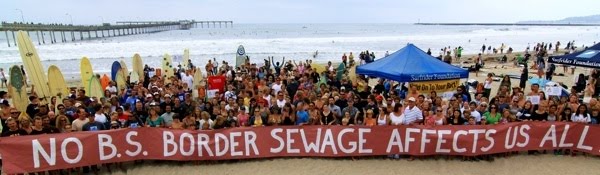
Collecting and treating Tijuana’s sewage has been the subject of binational efforts for decades. The city’s spills and overflows risk contaminating San Diego County beaches and threaten the Tijuana River estuary, a federally protected wetland. Although dry-weather flows have largely been eliminated, cross-border sewage flows during wet weather continue to shut down South Bay beaches.

Last year, officials on both sides of the border celebrated when Tijuana’s state-operated utility, the CESPT, inaugurated the Arturo Herrera sewage treatment plant in eastern Tijuana.

The opening launched Tijuana’s first comprehensive wastewater-reuse program, and the inauguration of a pipeline carrying 470,000 gallons a day from the plant to nearby Morelos Park.

The CESPT is completing a second treatment plant nearby called La Morita, and is planning a third one, Cueros de Venado. The three plants would feed the Guadalupe Valley aqueduct up to 25 million gallons a day of wastewater treated to a secondary level, which is acceptable for irrigation purposes.

Muñoz, the Baja California water planner, said the Guadalupe Valley pipeline proposal has a good chance of becoming a reality, but it faces several hurdles.

Because the state government can’t afford the project’s $169 million price tag, it is turning to the private sector. The winning bidder would recover its investment by selling the water. But to keep water rates down, federal funds are also needed, Muñoz said.

The state hopes to put to the project out to bid this year and begin construction in 2011, Muñoz said.

Before reaching the Guadalupe Valley, some of the water would be diverted to the Valle de las Palmas outside Tijuana, where a satellite city is under construction. Additional amounts would be delivered to agricultural communities along the way, with the remainder stored at a reservoir planned at the valley’s northern end, Muñoz said.

The water would receive further treatment before being delivered to growers, allowing it to be used in spray and drip irrigation systems.

Even with the Guadalupe Valley pipeline in the planning stages, Muñoz is looking ahead to a second project to use the rest of Tijuana’s treated wastewater.

He envisions a coastline pipeline that would supply communities with irrigation water for their green spaces.

“It would be much cheaper than the drinking water we are now using,” Muñoz said.

By Sandra Dibble, UNION-TRIBUNE STAFF WRITER

Wednesday, February 3, 2010


Top photo: Goat Canyon trash boom, bottom photo: Dairy Mart Bridge. 1/30/10, courtesy of WiLDCOAST
The following was posted on the website for Proyecto Fronterizo....

ATTENTION Tijuana residents, citizens, boys and girls, students, teachers, researchers, scientists, legislators, authorities. We all have to do with this environmental catastrophe.

Three weeks ago, local environmental organizations have witnessed a sudden rise of plastic pollution along Tijuana's shoreline. After two coastal cleanups during January 2010 1.3 tons of trash, composed mainly by plastics and more specifically by polystyrene, have been removed from the beach.

The first case was Cañada Azteca, where an impressive amount of such plastic material accumulated and was removed by a hundred people, including neighbors and volunteers from organizations joined by the Community Project Salvemos la Playa (Save the Beach) during an Emergency Coastal Cleanup on Sunday January 17th. Six hundred kilos were removed. That's 6 kilos each.

The second case was last Saturday, January 30th during the celebration of the first International Beach Conservancy Day at Playa El Vigía, which turned out to be more alarming. Back at Cañada we were able to restore the place but this time it was practically impossible due to the presence of millions of plastic particles. We're talking about an almost mile-long beach full with plastic containers, beverage bottles and caps, disposable cutlery and huge amounts of polistyrene (foam). Here more than 700 kilos were removed (that's 11.6 a piece). Not only was it overwhelming because of the vast extension buy also because of the particle's small size and the fact that it easily mixes with the beach's natural elements like sand and algae.

We truly believe this is an environmental catastrophe.

Through this message we want to raise some questions for us all. Questions that can help us solve this catastrophe TODAY but also in the FUTURE.

How do we clean up ALL THIS WASTE and stop it from affecting marine life?

How do all this plastics get to the ocean? How can we reduce or refuse its use?

What's the relation between this tragedy, drought, population growth and recent rainfall?

Do we have the courage to modify our consumption habits?

Are we willing to legislate around this matter? Are we willing to enforce laws?

Are we going to stay with our arms crossed, again?

What have you got to do with all these?

Tuesday, February 2, 2010

January Tijuana Sloughs Clean Up


Special thanks to those who came out to the rescheduled beach cleanup at the Tijuana Sloughs on Saturday. We collected about 660 lbs of trash in 2 hours and had about 100 volunteers show up. We would like to hold more of these Sloughs beach cleanups in the future and will be posting dates on the Surfrider calendar soon. Check out the rest of the pictures here.

Monday, February 1, 2010

Toxin probe eyes link to Tijuana

Nearly six years ago, environmentalists and government officials on both sides of the border cheered as cleanup efforts began on the site of Metales y Derivados, a notorious former American-owned lead smelter in Tijuana whose neighbors long had complained of health problems, including birth defects, that they blamed on the toxic-waste site.

As part of an agreement, roughly 2,000 tons of lead-contaminated soil and other waste removed from the site was trucked north to the United States for disposal. As it turns out, some of it wound up in a Central California toxic-waste dump that is now at the center of controversy over a suspected cluster of birth defects in families living nearby.

The waste trucked in from Tijuana, about 20 tons in all, constitutes a minute fraction of the toxic materials deposited in a landfill just outside Kettleman City, an agricultural community off Interstate 5 halfway between Los Angeles and the Bay Area. Still, news of the health concerns there, which have prompted a state investigation, have those who pushed for the cleanup in Tijuana shaking their heads.

“We feel terrible,” said Amelia Simpson, director of the border environmental justice campaign with the Environmental Health Coalition in San Diego, which worked with the U.S. and Mexican governments on the cleanup. “It is another low-income community, and in this case, Latino.”

On Friday, Gov. Arnold Schwarzenegger directed the California Department of Public Health and the state’s Environmental Protection Agency to send experts to Kettleman City to expand their investigation into what could be causing a higher-than-normal percentage of birth defects.

The state health department’s study is under way, with analyses of medical records for birth defects, cancer and asthma and monitoring of drinking water. The probe will include interviews with residents and reviews of soil samples, with initial findings expected to be made public Feb. 9.

According to a health survey that activists conducted in the small town, five of the 20 infants born between September 2007 and November 2008 to Kettleman City residents had a cleft palate or lip, and three of them have died.

“The question is, is there a cluster, and is there an environmental link?” said Al Lundeen, a spokesman for the state health department.

There was never an official study linking birth defects in Tijuana’s Ejido Chilpancingo, a poor residential area, to the adjacent Metales y Derivados site that sat exposed for years, long after the plant was closed.

“People never made a formal complaint because in our community, it is a stigma,” said Magdalena Cerda, a community organizer with the Environmental Health Coalition. “All of the cases we knew of, they kept them a secret.”

Cerda, who worked directly with residents near the Tijuana site, said health problems in the Chilpancingo community included cases of children born with hydrocephalus, an abnormal buildup of cerebrospinal fluid in the brain, and spina bifida, a defect in which the spinal canal and backbone do not close before birth.

Lead poisoning also interferes with development of the central nervous system and can cause learning and behavioral difficulties in children, who are particularly susceptible to the toxin.

Environmental activists have filed suit to stop a planned expansion of the Kettleman City site, which is owned by Chemical Waste Management Inc. and is believed to be the largest toxic-waste dump in the West.

While no one can say with certainty what is causing birth defects there, the director of the San Francisco-based environmental group Greenaction, which is involved in the lawsuit, said more monitoring of the site is needed.

“Monitoring is not what it needs to be, and we think the dump should never be expanded,” said Bradley Angel, executive director of the group.

Helen Herrera, a spokeswoman for Chemical Waste Management, said that the company supports the state’s health study but that there is no evidence linking the site to birth defects.

Metales y Derivados, which recycled vehicle and boat batteries brought in mostly from the United States, operated during the 1980s. The contamination was discovered in the early 1990s; in 1994, owner José Kahn moved to San Diego to avoid arrest after Mexican authorities shut down the business and tried to charge him with breaking environmental laws. Kahn has since died.

For years afterward, the property remained littered with 55-gallon drums and other containers filled with lead waste. More than a decade’s worth of efforts on behalf of environmental organizations on both sides of the border resulted in an agreement between the U.S. Environmental Protection Agency and its Mexican counterpart, Semarnat.

In June 2004, a portion of the waste from Metales y Derivados was sent to Kettleman City, according to a federal EPA report. As part of the binational cleanup deal, because Metales y Derivados was a U.S. company operating in Mexico under the North American Free Trade Agreement, the waste had to be removed to the country of origin. The rest of the roughly 2,000 tons of waste taken from the site and exported north went to a toxic-waste dump in Nevada.

More toxic waste would have been shipped back to the United States had it not been for the cost, said Saul Guzman, an official with Semarnat in Tijuana.

“That was the first solution, but it cost too much money,” Guzman said. “There was enough to move the first 2,000 tons, but there wasn’t enough money and we had to do what was most economically feasible.”

The alternate solution was to entomb an estimated 42,000 tons of remaining contaminated soil and waste beneath a concrete cap; about a year ago, a ceremony was held reopening the 4-acre site for use as a public park. The final cleanup cost was about $2 million, with the federal EPA contributing about $80,000.

By Leslie Berestein, UNION-TRIBUNE STAFF WRITER

Tuesday, January 26, 2010

Cross-Border Researchers Look For Message In Bottles

Last week's storms drenched Tijuana and forced more than 160 people from their homes. But the rain has helped a group of researchers who want to extend the life of San Diego's Tijuana Estuary.

The researchers have stationed themselves in a Tijuana canyon called Los Laureles.

It's a few miles from the border fence. About 80,000 people live there.

Since Monday, researchers have released more than 160 plastic bottles into the torrents of rainwater coursing through the canyon. That rainwater drains down into the Tijuana River Estuary.

Oscar Romo is the lead researcher on the project. He says they'll map the bottles' final resting places.

"So, the map would show me the plume of both where the solids and trash are going," Romo said.

Romo says that will help create a strategy to reduce storm impact on the estuary and the Tijuana neighborhoods in Los Laureles Canyon.

He says the study will help officials on both sides of the border know what infrastructure is needed to contain trash, sediment and runoff.

Romo hopes to apply the bottle study to other Tijuana canyons that also drain into the Tijuana River Estuary.

By Amy Isackson

KPBS

Monday, January 25, 2010

Storms trash Calif. beaches, bring snow to AZ, NM


SEAL BEACH, Calif. - The sky was blue and the sun bright for the first time in days after a week of powerful Southern California rain storms, but all Victoria Macey could see was the mountain of steaming trash and twisted debris on her favorite beach.

"I'm completely shocked. From our house, all we could see was gorgeous clouds and then we come down here and there's so much trash, it's really sad," Macey said as she photographed a sopping plastic baby doll propped atop an overturned end table. "I can't believe how many shopping carts there are. That's what blows my mind."

The mounds of soggy sofa cushions, rusted shopping carts, plastic children's toys, dented refrigerators and hundreds of plastic cans and food wrappers were just one calling card left by a week of punishing rain that pelted Southern California and went on to tangle with Arizona and New Mexico.

About 35 miles to the north of Seal Beach, hundreds of residents who evacuated from wildfire-scarred communities in the San Gabriel Mountain foothills north of Los Angeles returned home Saturday to assess the damage and remove mud and debris from their properties. There were no reports of major damage despite widespread concerns about mudslides and debris flows from the relentless rain.

About half of the 500 residents of a small western Arizona farming community who were evacuated after floodwaters swept through the town Thursday, returned Saturday. Muddied streets and damaged homes and businesses remained, and La Paz County sheriff's spokesman Lt. Glenn Gilbert said the community was in cleanup mode. Many said they were happy to survive the storm.

On Saturday, the Yavapai County Sheriff's Office announced the body of 6-year-old Jacob Baudek, who was swept away by rising by floodwaters in central Arizona Thursday, was spotted by hikers along the Agua Fria River and recovered from the river bank.

At higher elevations, forecasters warned of blowing and drifting snow and issued winter weather and wind advisories for southern New Mexico, with heavy snow expected in the Gila and Sacramento mountains. In the Guadalupe Mountains of southeastern New Mexico, wind gusts could top 90 mph on Saturday. More than 2 feet of snow have fallen in the Chama area in northern New Mexico, while parts of southwestern New Mexico got 27 inches of snow.

In Northern California, a rare tornado warning was issued Saturday in the San Francisco Bay area's Contra Costa County after a trained weather spotter reported seeing a funnel cloud. The National Weather Service said the cloud was seen about 9 miles south of Oakley, but it weakened without touching down and the agency's warning expired.

Harsh winter weather also hit the Dakotas, where thousands of people were without power after icy weather toppled miles of power lines. A winter storm carrying freezing rain and snow pushed through the region with blizzardlike conditions expected to develop over the weekend and into Monday.

Another smaller storm was forecast for Southern California beginning Tuesday evening and would last about two days, said National Weather Service meteorologist Steve Vanderburg.

But that storm was the farthest thing from the minds of weather-weary Southern Californians, who ventured to the region's famous beaches by the dozens on Saturday to bask in the sunshine and balmy temperatures. Many were shocked to find the trash from the storm's urban run-off and picked gingerly through tangled garbage to reach the water.

Fifty-two cities in the Los Angeles metropolitan area drain into the San Gabriel River bed and litter and garbage flow tens of miles to the ocean each time there's a heavy rain, said Kim Masoner, who founded Save Our Beach 10 years ago to combat the problem. Earlier, the couple worked with more than 1,400 volunteers to remove 12 large trash bins of debris from the river's mouth.

On Saturday, Steve Masoner pulled a waist-high white plastic rocking horse from the mess and propped it on the rocks lining the river mouth. His wife added a soggy Spiderman doll and a cracked SpongeBob SquarePants bike helmet and a swimming pool skimmer to the pile before helping her husband wrestle apart two shopping carts.

Similar scenes played out on beaches in Long Beach, Newport Beach and San Diego where the Los Angeles, Santa Ana and Tijuana rivers empty into the sea. Many surfers said they would avoid the water because of concerns about bacteria from storm run-off.

Meanwhile, the Surfrider Foundation canceled its beach cleanups through the end of the month near the Tijuana River because the hazardous waste created too much of a liability.

"Even if they do have gloves and masks, it's too dangerous," Dan Murphy, of Surfrider, said of the beach volunteers. "Whatever the trash is on the beach, it's been flowing in the sewage and it's covered with the stuff."