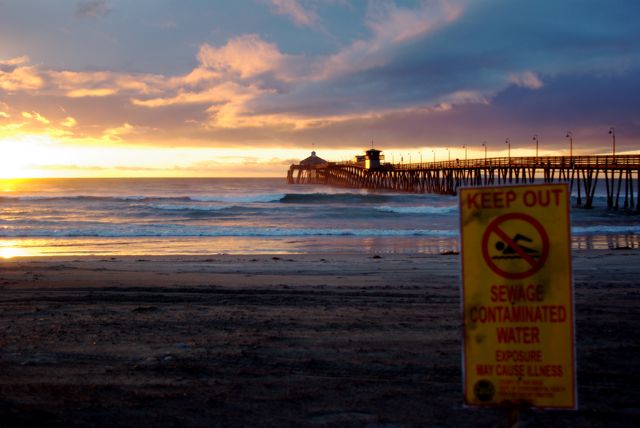
An expanded sewage-treatment plant more than a decade in the making has started processing wastewater in San Ysidro, and the agency in charge said it’s on track to meet a court-ordered deadline for reducing coastal water
pollution.
The
International Boundary and Water Commission is supposed to comply with U.S. Clean Water Act standards by Jan. 5 at its South Bay treatment facility, which handles up to 25 million gallons of raw sewage a day from Tijuana.
If the agency makes good on that effort, it will close a troubled chapter in the county’s most-polluted region and provide more momentum for a growing initiative to rid the border lands of trash, sediment and other pollutants. Even in its degraded state, the lower section of the river valley is prized by environmentalists because it’s one of the largest intact estuaries in California.
“Piece by piece, we are filling holes and dealing with the water quality issues on the border,” said Serge Dedina, head of the advocacy group Wildcoast in Imperial Beach. “It’s not just one solution. It’s a whole strategy.”
Upgrades at the
sewage treatment plant are at the core of the overall plan. The boundary commission built it in the late 1990s to combat millions of gallons of sewage that commonly flowed north across the border. Related problems go back 70 years or more because South Bay communities are downhill from Tijuana, a fast-growing city that’s long struggled to provide adequate sewage infrastructure.
The U.S. wastewater plant is run by the boundary commission, which operates sewage and flood control projects all along the
U.S.-Mexico border.
The San Ysidro facility has never met the “secondary treatment” standards in
U.S. law. That’s partly because the commission couldn’t afford to complete all of the necessary infrastructure within its initial budget of $239 million.
For much of the past decade, treatment upgrades were on hold while a
San Diego County company called Bajagua lobbied for a federal contract to build and operate a separate plant in Mexico. That effort fell apart in May 2008, when the
U.S. government decided to upgrade the San Ysidro facility rather than build from scratch in Tijuana.
The boundary commission eventually selected PCL Construction of Tempe, Ariz., as the lead contractor for an $88 million project that started in January 2009. The price tag jumped to $92.7 million after the contractor added crews to meet the court mandate.
“It’s been a long time coming,” said Steve Smullen, area operations manager for the U.S. section of the boundary commission.
As Smullen toured the grounds last week, workers put finishing touches around the cavernous concrete basins where wastewater is scrubbed. A faint smell of sewage hung over the site, which is within sight of the fence along the international border.
Scores of metal railings and freshly painted pumps glistened in the midday sun, while bacteria fed on the organic matter in the soupy brown water that swirled in new million-gallon tanks. Over the next several weeks, Smullen’s goal is to build up colonies of microscopic organisms so they can process full loads delivered from the adjacent primary treatment plant.
Once the solids and the bacteria are separated out, the treated water is supposed to meet secondary standards and be flushed to the
Pacific Ocean through an existing 3.5-mile pipe.
The current project doesn’t increase the plant’s overall capacity, but it will make the end product cleaner. The boundary commission needs to reduce the amount of suspended solids to comply with U.S. law, and it must decrease the toxicity of the water it discharges.
“We are hopeful the problems will be fixed,” Smullen said. “Time will tell.”
It’s not clear how much the work will improve the ocean water near the South County shoreline, which is bedeviled by multiple sources of contamination that routinely sicken surfers.
David Gibson, executive officer at the San Diego Regional Water Quality Control Board, said he is optimistic about the expanded plant but he warned that there may be hiccups along the way.
He said the facility is hard to operate because Mexican factories don’t have the same kinds of controls as U.S. companies on the compounds they discharge to the sewage system. In addition, Tijuana residents typically use less water than San Diego County residents and that makes their sewage more concentrated and tougher treat.
Two other main pollutants in the watershed — trash and sediment — also present a major challenge. The regional board is drafting regulations to limit those sources of contamination in the
Tijuana River, and it’s targeting the U.S. government as the responsible party.
No one is sure how much that strategy will cost or how long it will take, but Gibson said he aims to force more cleanup efforts as an alliance of more than 30 groups and agencies try to gain ground with cooperative efforts. That binational initiative involves crafting long-term plans for trash collectors, larger basins for capturing mud and building an environmental ethic among Tijuana residents.
“In the end, it will require the kind of capital investment, operations and maintenance to manage sediment and trash that we currently have for sewage,” Gibson said. “It will not be cheap and it will not be simple.”