
Wednesday, January 26, 2011

Wednesday, January 19, 2011
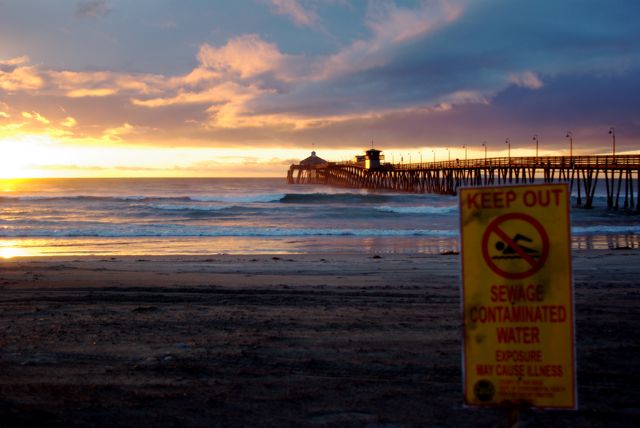
Massive sewage spill fouls Imperial Beach

By Sandra Dibble
and Mike Lee
Originally published January 18, 2011 at 3:06 p.m., updated January 18, 2011 at 8:44 p.m.
Sewage spill
An estimated 1.3 million gallons a day of sewage are flowing into the ocean just south of the international border, in what will rank among the largest single incidents to affect San Diego County in the past decade.
The ongoing leak adds a potent pollutant to coastal waters that currents commonly push north into the United States, where they mix with contaminated flow from the Tijuana River, which has lead to beach closures in South County for the past month.
Estimates of the spill size vary greatly — from more than 30 million gallons by environmentalists to just a few million gallons by wastewater officials in Mexico. Either way, the situation provides a vivid reminder that despite numerous upgrades to the sewage system in Tijuana, it remains a chronic environmental and human health problem with roots going back more than 70 years.
Baja California’s top health authority on Tuesday closed the beaches near the leak at Playas de Tijuana as a precautionary measure. Surfers in South San Diego County said they were concerned about getting sick from the tainted water.
The break was about one mile south of the border in a pipe linked to a pump station that lifts sewage to the Punta Bandera treatment plant. The state’s health department said a pipe ruptured when the ground gave way after December’s rainstorms.
A central question is when the leak started. Baja wastewater officials said Tuesday the major problems started last weekend and they acted as quickly as possible to a situation that started small and blew up without warning.
Environmentalists in Mexico said major flows began before Christmas. They and their counterparts in the United States questioned whether Mexico acted fast enough to address the break and issue warnings.
“This is pretty serious and demonstrates a breakdown in communication” between Mexican and U.S. officials, said Serge Dedina, head of the environmental group Wildcoast in Imperial Beach. “This is precisely an issue we have been trying to deal with — just getting basic notifications on sewage spills in Tijuana. Authorities have placed thousands of people at risk.”
Officials initially believed the problem was an overflow that typically occurs during rainstorms when sewage and stormwater mix in overloaded pipes, said Agustin Rojas, spokesman for the CESPT, the acronym of the state public service commission of Tijuana.
He said the scope of the issue was not initially apparent because it involved an underground sinkhole that formed around Dec. 29 but did not immediately damage the 30-inch pipe.
“We believe it began to have problems, but the water wasn’t flowing to the ocean yet,” Rojas said.
On Sunday, he said, “We had not detected the magnitude of the problem. ... It wasn’t until Monday.”
He said it would take another couple of days to stop the flow. The repairs involve replacing a 250-foot portion of the collector pipe that’s buried 15 feet below ground.
“We’ve got crews working long-hour shifts. It’s not an easy job, but they are committed to the task.”
Margarita Diaz, head of Probea, a Playas de Tijuana-based environmental organization, said the problems date back to Dec. 23.
“The collector was damaged, the ground collapsed, and it folded, and plugged it up. This caused the sewage to flow north toward the manholes. As it could not go to the pump station, it flowed through the drains.”
Diaz said the issue of the sewage overflows reached her office at the beginning of January, when local residents called and complained. When she called the CESPT, she said the common response was that the engineer was on vacation.
The Playas beach was closed Tuesday afternoon. “But this should have happened a long time ago,” she said. “It should have happened immediately, from the moment that the spill was detected. They were three weeks late.”
Mark McPherson, chief of land and water quality for San Diego County’s environmental health agency, said Tuesday afternoon that he had received no official notice of the incident. In this case, he said an alert would not have made a major difference because the Tijuana River is still flowing with millions of gallons a day of sewage-tainted water and the county has maintained beach closures for weeks in the South Bay because of that.
Dedina at Wildcoast said the problems at Playas de Tijuana likely are contributing to the mess caused by the Tijuana River.
“The stench at the south end of IB this morning was overpowering,” he said.
Conditions were worse south of the international border.
“I have been watching and smelling a stream of untreated sewage run down the street next to my house in Playas de Tijuana and to the ocean in a constant flow,” said resident Scott S. Peters. “The authorities have simply removed the manhole covers on my street and have been letting the sewage flow like a river since the storm a few weeks ago.”
Wastewater has been a major source of tension along the border since the early 1900s because Tijuana’s sewage system has not kept up with growth. Raw sewage flows into the Tijuana River whenever it rains. Agencies on both sides of the border have made big strides to cut down the pollution by building treatment plants and other facilities.
Friday, January 14, 2011
San Diego Group Using Grant To Reduce Cross Border Pollution

A San Diego based environmental group is using a grant from a federal agency to reduce cross-border trash and pollution. The WiLDCOAST project will benefit beaches on either side of the border.
The $50,000 Environmental Protection Agency grant will fund WiLDCOAST's project called Clean Canyon (Cañón Limpio) for 16 months.
Ben McCue with WiLDCOAST said the effort focuses on the Los Laureles Canyon, a sub-basin of the Tijuana River Watershed and drainage area.
"This canyon is literally a stone's throw from the U.S./Mexico border fence," said McCue. "And all of the trash that's not collected in this canyon, with next rain will end up in the Tijuana Estuary and eventually off our border beaches."
Many people living in the canyon, he said, don't have basic municipal services, including trash collection.
"The project will be giving residents tools needed to improve trash management in their community using activities such as workshops, leadership trainings and clean-up events," McCue said. "Reducing pollution includes getting residents to recycle trash and use composting."
McCue said the project will start in February.
He said there is a movement in Tijuana to eliminate illegal settlements that create much of the trash and sewage problems that foul beaches on both sides of the border.
"Until those areas are eliminated or are provided basic services, such as sewage treatment and trash collection services, we're going to continue to feel the effects downstream in San Diego," said McCue. "Everyone recognizes that the city of Tijuana has a lot of work to do to get the city completely plumbed for sewage treatment and set up for trash collection."
McCue said there's always going to be a need for local Tijuana communities to improve trash collection and recycling through their own resources.
"Leadership training on how to mobilize their neighbors to work on innovative composting and recycling projects will clearly benefit the Tijuana Estuary and San Diego beaches," said McCue.
Beach water quality has long been an issue along the U.S.-Mexico border.
McCue said the non-profit WiLDCOAST works with border communities and agencies of both countries to reduce the sources of pollution fouling the region's waterways.
He said the project is part of EPA’s Border 2012 Program, which works to address shared environmental problems across the US-Mexico border.
"All of the border states have cross-border pollution problems," McCue said. "The binational Border 2012 program has work groups in all of the US-Mexico border states."
The $50,000 Environmental Protection Agency grant will fund WiLDCOAST's project called Clean Canyon (Cañón Limpio) for 16 months.

Ben McCue with WiLDCOAST said the effort focuses on the Los Laureles Canyon, a sub-basin of the Tijuana River Watershed and drainage area.
"This canyon is literally a stone's throw from the U.S./Mexico border fence," said McCue. "And all of the trash that's not collected in this canyon, with next rain will end up in the Tijuana Estuary and eventually off our border beaches."
Many people living in the canyon, he said, don't have basic municipal services, including trash collection.
"The project will be giving residents tools needed to improve trash management in their community using activities such as workshops, leadership trainings and clean-up events," McCue said. "Reducing pollution includes getting residents to recycle trash and use composting."
McCue said the project will start in February.
He said there is a movement in Tijuana to eliminate illegal settlements that create much of the trash and sewage problems that foul beaches on both sides of the border.
"Until those areas are eliminated or are provided basic services, such as sewage treatment and trash collection services, we're going to continue to feel the effects downstream in San Diego," said McCue. "Everyone recognizes that the city of Tijuana has a lot of work to do to get the city completely plumbed for sewage treatment and set up for trash collection."
McCue said there's always going to be a need for local Tijuana communities to improve trash collection and recycling through their own resources.
"Leadership training on how to mobilize their neighbors to work on innovative composting and recycling projects will clearly benefit the Tijuana Estuary and San Diego beaches," said McCue.
Beach water quality has long been an issue along the U.S.-Mexico border.
McCue said the non-profit WiLDCOAST works with border communities and agencies of both countries to reduce the sources of pollution fouling the region's waterways.
He said the project is part of EPA’s Border 2012 Program, which works to address shared environmental problems across the US-Mexico border.
"All of the border states have cross-border pollution problems," McCue said. "The binational Border 2012 program has work groups in all of the US-Mexico border states."
Monday, January 3, 2011
Pictures taken at Border Field State Park during the recent rainstorms


On 12/20 and 12/21/2010, a few of us drove down to Border field State Park and captured some pictures at the Goat Canyon Sediment basins, Smugglers Gulch, Dairy Mart Bridge, Saturn Blvd and Hollister Street. Not only did we see tons of plastic, styrofoam, sewage, and trash flowing from the Tijuana River, but we saw humans getting rescued. Some of the shots are pretty eye opening to say the least.
http://www.flickr.com/photos/surfridersandiego/sets/72157625743131314/
http://www.flickr.com/photos/surfridersandiego/sets/72157625743131314/
Friday, December 3, 2010
South San Diego Water Quality Workshop
Join Scripps Institution of Oceanography, WiLDCOAST, the County of San Diego's Department of Environnmental Health, and San Diego Coastkeeper at TRNERR (Tijuana Estuary Visitor Center, 301 Caspian Way, Imperial Beach, California.) on December 7th from 6-8pm to learn about the process that goes into monitoring ocean water quality and influences beach closures and advisories. Walk away with practical tools that will help you to know when the water is safe and how to safeguard your health -- and some great food and raffle prizes too!
Protecting and preserving nature’s systems

Mike A. McCoy’s passion for achieving a better understanding of the interrelationship of ecological systems has evolved over the decades. “It wasn’t much understood in the ’60s,” he says.
As a member of the stakeholders group setting up the Marine Life Protection Act Initiative for the California Department of Fish and Game, Mike travels the Southern California coast intent on preserving marine and estuarine systems.
“We have to understand and revamp the way we think. We have to look at any system like a microcosm — look locally and think globally,” Mike says.
Mike’s work started more than 40 years ago. A proposed marina created by dredging the Tijuana Estuary caught Mike’s interest in 1970. He recognized the importance of preserving it and its wildlife as one of the last intact salt marsh ecosystems in Southern California.
“If we fragment ecological systems, remove corridors and connections, we’ll slowly destroy their complexity and vibrancy,” he notes.
But about one-third of the community wanted to protect the estuary and two-thirds wanted a marina, he recalls. The creation of a marina meant money for the local tax base.
“The importance of 1.8 million people living in proximity to the estuary was an educational opportunity for so many to learn about the critical role these systems play in their daily lives,” Mike states. “Estuaries are the nurseries of the sea.”
In spearheading the 10-year effort to save the estuary, Mike challenged numerous cities and the San Diego County Comprehensive Planning Organization, including area mayors.
“The road was not easy and was paved with stress and violence along the way,” he remembers. “Death threats, bullets and loosening of lug nuts on our wheels happened during this time.”
With congressional support and that of the Southwest Wetlands Interpretive Association (SWIA), of which Mike was one of the founding members and now serves as president, the Tijuana Slough National Wildlife Refuge was acquired in 1980. The Tijuana River National Estuarine Research Reserve was established in 1982. By 2005 the Tijuana Estuary, the most southwesterly coastal wetland in the U.S., was dedicated as a Ramsar Wetland of International Importance.
“Mike is one of those most responsible for bridging the political gap and keeping this estuary from development, which in turn allowed for a two-country stewardship for the benefit of this wetland of international importance,” says Bob Miller, SWIA vice president.
— Marty Coffin Evans
As a member of the stakeholders group setting up the Marine Life Protection Act Initiative for the California Department of Fish and Game, Mike travels the Southern California coast intent on preserving marine and estuarine systems.
“We have to understand and revamp the way we think. We have to look at any system like a microcosm — look locally and think globally,” Mike says.
Mike’s work started more than 40 years ago. A proposed marina created by dredging the Tijuana Estuary caught Mike’s interest in 1970. He recognized the importance of preserving it and its wildlife as one of the last intact salt marsh ecosystems in Southern California.
“If we fragment ecological systems, remove corridors and connections, we’ll slowly destroy their complexity and vibrancy,” he notes.
But about one-third of the community wanted to protect the estuary and two-thirds wanted a marina, he recalls. The creation of a marina meant money for the local tax base.
“The importance of 1.8 million people living in proximity to the estuary was an educational opportunity for so many to learn about the critical role these systems play in their daily lives,” Mike states. “Estuaries are the nurseries of the sea.”
In spearheading the 10-year effort to save the estuary, Mike challenged numerous cities and the San Diego County Comprehensive Planning Organization, including area mayors.
“The road was not easy and was paved with stress and violence along the way,” he remembers. “Death threats, bullets and loosening of lug nuts on our wheels happened during this time.”
With congressional support and that of the Southwest Wetlands Interpretive Association (SWIA), of which Mike was one of the founding members and now serves as president, the Tijuana Slough National Wildlife Refuge was acquired in 1980. The Tijuana River National Estuarine Research Reserve was established in 1982. By 2005 the Tijuana Estuary, the most southwesterly coastal wetland in the U.S., was dedicated as a Ramsar Wetland of International Importance.
“Mike is one of those most responsible for bridging the political gap and keeping this estuary from development, which in turn allowed for a two-country stewardship for the benefit of this wetland of international importance,” says Bob Miller, SWIA vice president.
— Marty Coffin Evans
Border sewage plant nears completion

An expanded sewage-treatment plant more than a decade in the making has started processing wastewater in San Ysidro, and the agency in charge said it’s on track to meet a court-ordered deadline for reducing coastal water pollution.
The International Boundary and Water Commission is supposed to comply with U.S. Clean Water Act standards by Jan. 5 at its South Bay treatment facility, which handles up to 25 million gallons of raw sewage a day from Tijuana.
If the agency makes good on that effort, it will close a troubled chapter in the county’s most-polluted region and provide more momentum for a growing initiative to rid the border lands of trash, sediment and other pollutants. Even in its degraded state, the lower section of the river valley is prized by environmentalists because it’s one of the largest intact estuaries in California.
“Piece by piece, we are filling holes and dealing with the water quality issues on the border,” said Serge Dedina, head of the advocacy group Wildcoast in Imperial Beach. “It’s not just one solution. It’s a whole strategy.”
Upgrades at the sewage treatment plant are at the core of the overall plan. The boundary commission built it in the late 1990s to combat millions of gallons of sewage that commonly flowed north across the border. Related problems go back 70 years or more because South Bay communities are downhill from Tijuana, a fast-growing city that’s long struggled to provide adequate sewage infrastructure.
The U.S. wastewater plant is run by the boundary commission, which operates sewage and flood control projects all along the U.S.-Mexico border.
The San Ysidro facility has never met the “secondary treatment” standards in U.S. law. That’s partly because the commission couldn’t afford to complete all of the necessary infrastructure within its initial budget of $239 million.
For much of the past decade, treatment upgrades were on hold while a San Diego County company called Bajagua lobbied for a federal contract to build and operate a separate plant in Mexico. That effort fell apart in May 2008, when the U.S. government decided to upgrade the San Ysidro facility rather than build from scratch in Tijuana.
The boundary commission eventually selected PCL Construction of Tempe, Ariz., as the lead contractor for an $88 million project that started in January 2009. The price tag jumped to $92.7 million after the contractor added crews to meet the court mandate.
“It’s been a long time coming,” said Steve Smullen, area operations manager for the U.S. section of the boundary commission.
As Smullen toured the grounds last week, workers put finishing touches around the cavernous concrete basins where wastewater is scrubbed. A faint smell of sewage hung over the site, which is within sight of the fence along the international border.
Scores of metal railings and freshly painted pumps glistened in the midday sun, while bacteria fed on the organic matter in the soupy brown water that swirled in new million-gallon tanks. Over the next several weeks, Smullen’s goal is to build up colonies of microscopic organisms so they can process full loads delivered from the adjacent primary treatment plant.
Once the solids and the bacteria are separated out, the treated water is supposed to meet secondary standards and be flushed to the Pacific Ocean through an existing 3.5-mile pipe.
The current project doesn’t increase the plant’s overall capacity, but it will make the end product cleaner. The boundary commission needs to reduce the amount of suspended solids to comply with U.S. law, and it must decrease the toxicity of the water it discharges.
“We are hopeful the problems will be fixed,” Smullen said. “Time will tell.”
It’s not clear how much the work will improve the ocean water near the South County shoreline, which is bedeviled by multiple sources of contamination that routinely sicken surfers.
David Gibson, executive officer at the San Diego Regional Water Quality Control Board, said he is optimistic about the expanded plant but he warned that there may be hiccups along the way.
He said the facility is hard to operate because Mexican factories don’t have the same kinds of controls as U.S. companies on the compounds they discharge to the sewage system. In addition, Tijuana residents typically use less water than San Diego County residents and that makes their sewage more concentrated and tougher treat.
Two other main pollutants in the watershed — trash and sediment — also present a major challenge. The regional board is drafting regulations to limit those sources of contamination in the Tijuana River, and it’s targeting the U.S. government as the responsible party.
No one is sure how much that strategy will cost or how long it will take, but Gibson said he aims to force more cleanup efforts as an alliance of more than 30 groups and agencies try to gain ground with cooperative efforts. That binational initiative involves crafting long-term plans for trash collectors, larger basins for capturing mud and building an environmental ethic among Tijuana residents.
“In the end, it will require the kind of capital investment, operations and maintenance to manage sediment and trash that we currently have for sewage,” Gibson said. “It will not be cheap and it will not be simple.”
The International Boundary and Water Commission is supposed to comply with U.S. Clean Water Act standards by Jan. 5 at its South Bay treatment facility, which handles up to 25 million gallons of raw sewage a day from Tijuana.
If the agency makes good on that effort, it will close a troubled chapter in the county’s most-polluted region and provide more momentum for a growing initiative to rid the border lands of trash, sediment and other pollutants. Even in its degraded state, the lower section of the river valley is prized by environmentalists because it’s one of the largest intact estuaries in California.
“Piece by piece, we are filling holes and dealing with the water quality issues on the border,” said Serge Dedina, head of the advocacy group Wildcoast in Imperial Beach. “It’s not just one solution. It’s a whole strategy.”
Upgrades at the sewage treatment plant are at the core of the overall plan. The boundary commission built it in the late 1990s to combat millions of gallons of sewage that commonly flowed north across the border. Related problems go back 70 years or more because South Bay communities are downhill from Tijuana, a fast-growing city that’s long struggled to provide adequate sewage infrastructure.
The U.S. wastewater plant is run by the boundary commission, which operates sewage and flood control projects all along the U.S.-Mexico border.
The San Ysidro facility has never met the “secondary treatment” standards in U.S. law. That’s partly because the commission couldn’t afford to complete all of the necessary infrastructure within its initial budget of $239 million.
For much of the past decade, treatment upgrades were on hold while a San Diego County company called Bajagua lobbied for a federal contract to build and operate a separate plant in Mexico. That effort fell apart in May 2008, when the U.S. government decided to upgrade the San Ysidro facility rather than build from scratch in Tijuana.
The boundary commission eventually selected PCL Construction of Tempe, Ariz., as the lead contractor for an $88 million project that started in January 2009. The price tag jumped to $92.7 million after the contractor added crews to meet the court mandate.
“It’s been a long time coming,” said Steve Smullen, area operations manager for the U.S. section of the boundary commission.
As Smullen toured the grounds last week, workers put finishing touches around the cavernous concrete basins where wastewater is scrubbed. A faint smell of sewage hung over the site, which is within sight of the fence along the international border.
Scores of metal railings and freshly painted pumps glistened in the midday sun, while bacteria fed on the organic matter in the soupy brown water that swirled in new million-gallon tanks. Over the next several weeks, Smullen’s goal is to build up colonies of microscopic organisms so they can process full loads delivered from the adjacent primary treatment plant.
Once the solids and the bacteria are separated out, the treated water is supposed to meet secondary standards and be flushed to the Pacific Ocean through an existing 3.5-mile pipe.
The current project doesn’t increase the plant’s overall capacity, but it will make the end product cleaner. The boundary commission needs to reduce the amount of suspended solids to comply with U.S. law, and it must decrease the toxicity of the water it discharges.
“We are hopeful the problems will be fixed,” Smullen said. “Time will tell.”
It’s not clear how much the work will improve the ocean water near the South County shoreline, which is bedeviled by multiple sources of contamination that routinely sicken surfers.
David Gibson, executive officer at the San Diego Regional Water Quality Control Board, said he is optimistic about the expanded plant but he warned that there may be hiccups along the way.
He said the facility is hard to operate because Mexican factories don’t have the same kinds of controls as U.S. companies on the compounds they discharge to the sewage system. In addition, Tijuana residents typically use less water than San Diego County residents and that makes their sewage more concentrated and tougher treat.
Two other main pollutants in the watershed — trash and sediment — also present a major challenge. The regional board is drafting regulations to limit those sources of contamination in the Tijuana River, and it’s targeting the U.S. government as the responsible party.
No one is sure how much that strategy will cost or how long it will take, but Gibson said he aims to force more cleanup efforts as an alliance of more than 30 groups and agencies try to gain ground with cooperative efforts. That binational initiative involves crafting long-term plans for trash collectors, larger basins for capturing mud and building an environmental ethic among Tijuana residents.
“In the end, it will require the kind of capital investment, operations and maintenance to manage sediment and trash that we currently have for sewage,” Gibson said. “It will not be cheap and it will not be simple.”
Subscribe to:
Posts (Atom)